The fading light of Kalithia
Bound by DarknessThe fading light of Kalithia is the central condition behind the Kalith people’s physical decline, lost traditions, and growing vulnerability to violence. It has diminished the healing gift once associated with the Kalith and contributed to the sickness that transformed warriors who might once have been honorable into dangerous, suspicious figures. Against that darkness, Larem q’Jones’s experience in the human world presents a fragile counterforce: sunlight strengthens a nearly forgotten ability, but the recovery of that gift cannot undo the losses already suffered by his people or resolve the question of where he belongs.
Definition and Cultural Consequences
The fading light is described as a weakening of the light in Kalithia, a condition severe enough to make the healers of light and their skills seem lost to the darkening. A Kalith warrior confronting Larem q’Jones insists that the old healing powers have disappeared, while Larem answers that the light in the human world has strengthened his own gift. The contrast establishes the fading light not merely as an environmental change but as a force that has altered Kalith culture, memory, and expectations. What was once part of the people’s inheritance has become almost legendary, and Larem’s restored capacity appears extraordinary precisely because Kalithia can no longer sustain it.
The decline also frames the sickness that has overtaken Kalith warriors. Larem understands that the fallen Kalith were effectively lost when the sickness first began whispering in their minds; if they had not died by his sword, they would have faced a brutal death at the hands of the Paladins. His grief therefore carries two histories at once. He mourns the bodies before him, but he also mourns a people whose moral and physical collapse began earlier, under conditions that stripped their lives of the possibility of recovery. The fading light makes the battlefield the final expression of a much older catastrophe.
Larem q’Jones and the Return of Healing
In Kalithia, Larem q’Jones could perform only small acts of healing, such as closing cuts or easing minor pain. The brighter sun of the human world changes that limit. When Hunter Fitzsimon was dying from a gunshot wound, Larem took the risk of using his gift and helped Hunter return to health faster than he otherwise would have; by the following morning, Hunter’s injuries were nearly gone. Larem emphasizes that this was an exceptional success rather than a dependable power. His ability does not always work as it should, and he had not previously used it to treat major injuries in either humans or Kalith.
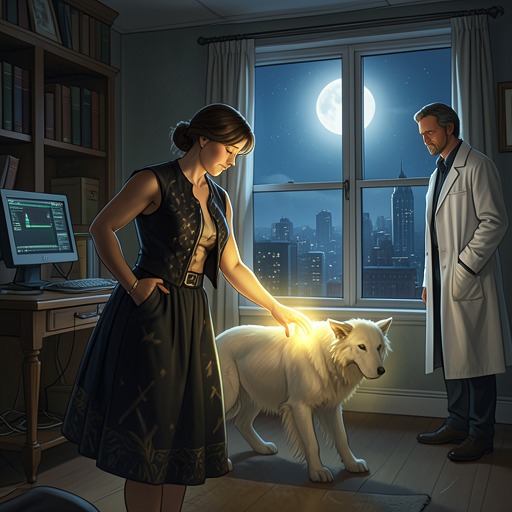
His practice is consequently cautious and improvised. He works on abused animals at a shelter, where his healing helps Chance survive injuries that would otherwise have killed him and may also contribute to the animal’s gradual return of trust. The detail gives the fading light a practical human-world counterimage: recovery begins not through a grand restoration of Kalithia, but through small acts of care performed on vulnerable bodies. Larem’s gift remains uncertain, yet it becomes meaningful because he uses it where help is needed rather than treating it as proof of superiority.
The limits of that recovery are made devastatingly clear when Larem tries to save a dying Kalith warrior. He chants, raises his ceremonial medicine knife toward the ceiling, and asks the gods to share their healing strength, but the warrior dies before the ritual can be completed. Larem throws the knife down the tunnel, curses his failure, and holds the body while whispering death prayers for all the fallen Kalith. His restored gift can bring Hunter back more quickly and save Chance, but it cannot reliably reverse the damage produced by Kalithia’s darkening. The failure preserves the condition’s tragic scale: the human world may awaken an old power, but it cannot simply return the dead or repair an entire civilization.
Medical and Institutional Echoes
The fading light also shapes how Kalith and Paladin bodies are treated in the human world. When Larem is wounded, Laurel Young explains that his blood differs sufficiently from human and Paladin blood that neither could safely be used for a transfusion. Barak q’Young donates a pint, but the supply is insufficient, leaving the medical team to rely on plasma, intravenous fluids, and time, with Larem’s own partial healing ability aiding his recovery. His condition exposes the practical consequences of biological difference while also showing that the boundaries between species are not absolute: his blood is incompatible with ordinary emergency treatment, yet his healing resembles the Paladins’ enough to help him survive.
The same medical logic appears in the treatment of Paladins whose repeated deaths and returns have pushed their bodies toward dangerous limits. Sasha Willis’s administration ends Colonel Kincade’s practice of using scans as punishment and orders diagnostic procedures to occur on a regular schedule, with more frequent monitoring only when the Handlers consider a case medically necessary. She also authorizes additional staff and funding for Dr. Young’s studies. The policy does not cure the fading light, but it establishes a deliberate contrast with systems that turn examination into coercion. Bodies marked by illness, altered biology, or repeated injury are no longer supposed to be controlled through arbitrary testing.
Pregnancy adds another layer to the problem of medical knowledge. Larem q’Jones recognizes Sasha Willis’s pregnancy through a Kalith gift that had been lost for generations because of Kalithia’s fading light. Yet human medicine has no established framework for a Kalith-human pregnancy. Laurel therefore plans an obstetric examination and asks Larem to identify differences in Kalith gestation, since the normal human period of nine months may not apply. Larem intends to ask Hunter Fitzsimon to obtain a medical book from Sworn Guardian Berk. The scene turns the fading light into a question of transmission: knowledge once disappearing in Kalithia may need to be recovered through cooperation between worlds.
Darkness, Prejudice, and the Human World
The condition’s consequences are intensified by the way humans interpret Kalith decline. Rumors describe Paladins as consorting with the enemy, treating Kalith as dangerous outsiders, and wasting resources to save them. George goes so far as to say that Larem’s death would have been beneficial, while guards question why Kalith are being treated as partners, instructors, or paid workers. Duke hears that Seattle’s budget supports the salaries of three adult Kalith, including Barak q’Young and Larem q’Jones, and wonders whether their presence conceals an intelligence-gathering mission involving human firearms and stun guns.
These suspicions convert a real crisis into a rationale for exclusion. Human observers often call the Kalith “Others,” “pets,” or enemies even when the evidence before them includes cooperation, medical rescue, teaching, and personal loyalty. The fading light has made Kalith vulnerable, but human prejudice threatens to make that vulnerability politically useful. Larem’s defense of a human woman, his Blademate bond with Lusahn q’Arc, and his oath to protect anyone unable to defend themselves challenge the assumption that species determines moral allegiance. His conduct demonstrates that the darkening of Kalithia has not erased honor; it has made honor harder to recognize and harder to preserve.
Significance and Ongoing Tension
For Larem q’Jones, living under stronger light produces an existential choice. He once hoped to return to Kalithia, but the recovery of his healing ability and his relationships in the human world complicate that desire. He now has friends among those he had always considered enemies, and he recognizes that everyone living in the light must come to terms with that contradiction. The fading light therefore defines more than a planetary or cultural decline. It creates the pressure behind his exile, his renewed usefulness, his grief, and his uncertain future.
The condition functions as both an external disaster and a measure of what contact between worlds can change. Human sunlight can strengthen Larem’s gift; human institutions can provide medical care and research; human relationships can offer forms of solidarity unavailable amid Kalithia’s collapse. None of these gains restores the lost world intact. The dying Kalith warrior, the scarce compatible blood, the uncertain pregnancy, and the suspicion surrounding Kalith presence all show that survival requires improvisation rather than a simple return to the past. The fading light remains the shadow against which every act of healing is judged: each recovery is real, but each also reminds the characters how much has already been lost.